
Context
Submitted through the COP31 Sustainable Transformation Awards · SKD Türkiye (WBCSD Global Network Partner)
İmeceMobil Tarım Platformu Elektronik Hizmetler Ticaret A.Ş. is an agricultural technology company in Türkiye with fewer than 50 employees. It began in 2019 as a corporate entrepreneurship venture within Türkiye İş Bankası and completed its incorporation as a separate company in January 2023.
Agricultural production in the country remains organised largely around experience rather than measured data. Producers, and smallholders in particular, have limited access to agronomic knowledge and to the technologies required to manage water, fertiliser and crop protection precisely. Exposure to the climate crisis increases the consequences of those decisions.
The gap is also commercially relevant for the parent bank. Its agricultural specialist branches serve producer customers whose input costs, yields and repayment capacity depend on field-level decisions, and better field data can make agricultural credit scoring more transparent. Low digital literacy and limited technology infrastructure in rural areas were the main barriers to addressing it.
Location of the initiative: Türkiye, across regions with differing microclimates and crop patterns
Solution
The company operates a platform that brings agricultural, technology and financial services together for producers. A set of core services is provided free of charge, and value-added digital services are priced to remain affordable for smallholders.
The platform has four components:
-
an Agriculture Module carrying the free services and the value-added agronomic services;
-
ProPanel, a web platform used to optimise contracted and large-scale production;
-
a Finance Module that compares agricultural loans and cards by price and term and allows online application; and
-
a Market Module, an electronic marketplace for inputs, machinery and equipment.
In 2024 the company and the parent bank launched the Agricultural Technologies Ambassadorship for customers of the bank's agricultural specialist branches, a hybrid guidance model in which digital services are delivered together with face-to-face advice from agronomists who visit the fields.
The service covered 620 producers in 2024 and 875 in 2025, against a target of 1,000 in 2026. Agricultural land followed through field visits and satellite imagery increased from 658 plots in 2024 to 810 in 2025. Average monthly active users of the platform exceeded 200,000 in 2026, and purchases through the Market Module approached TRY 900 million over 2025–2026.
Figure 1: Producer Journey: Integrated Digital Agriculture Ecosystem
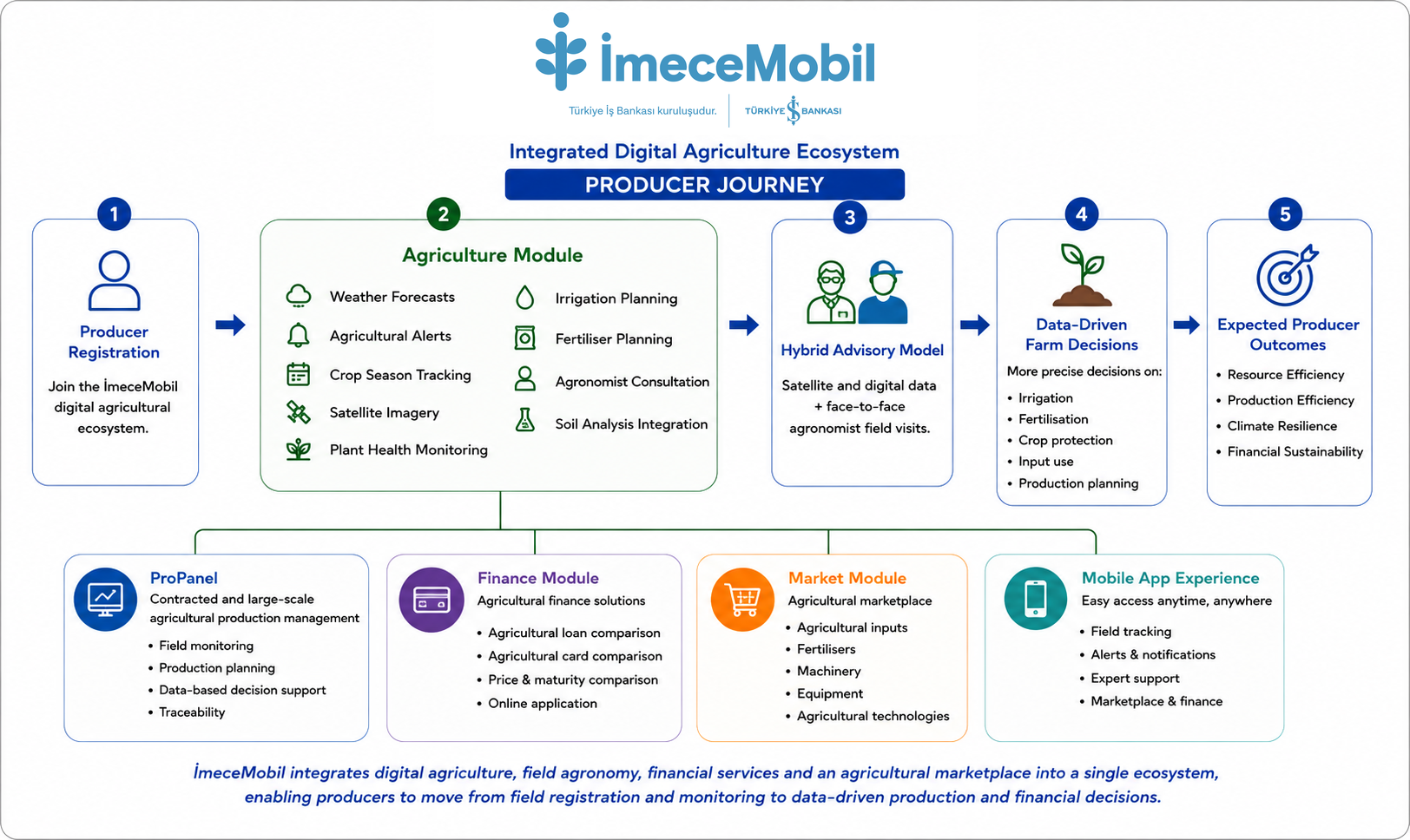
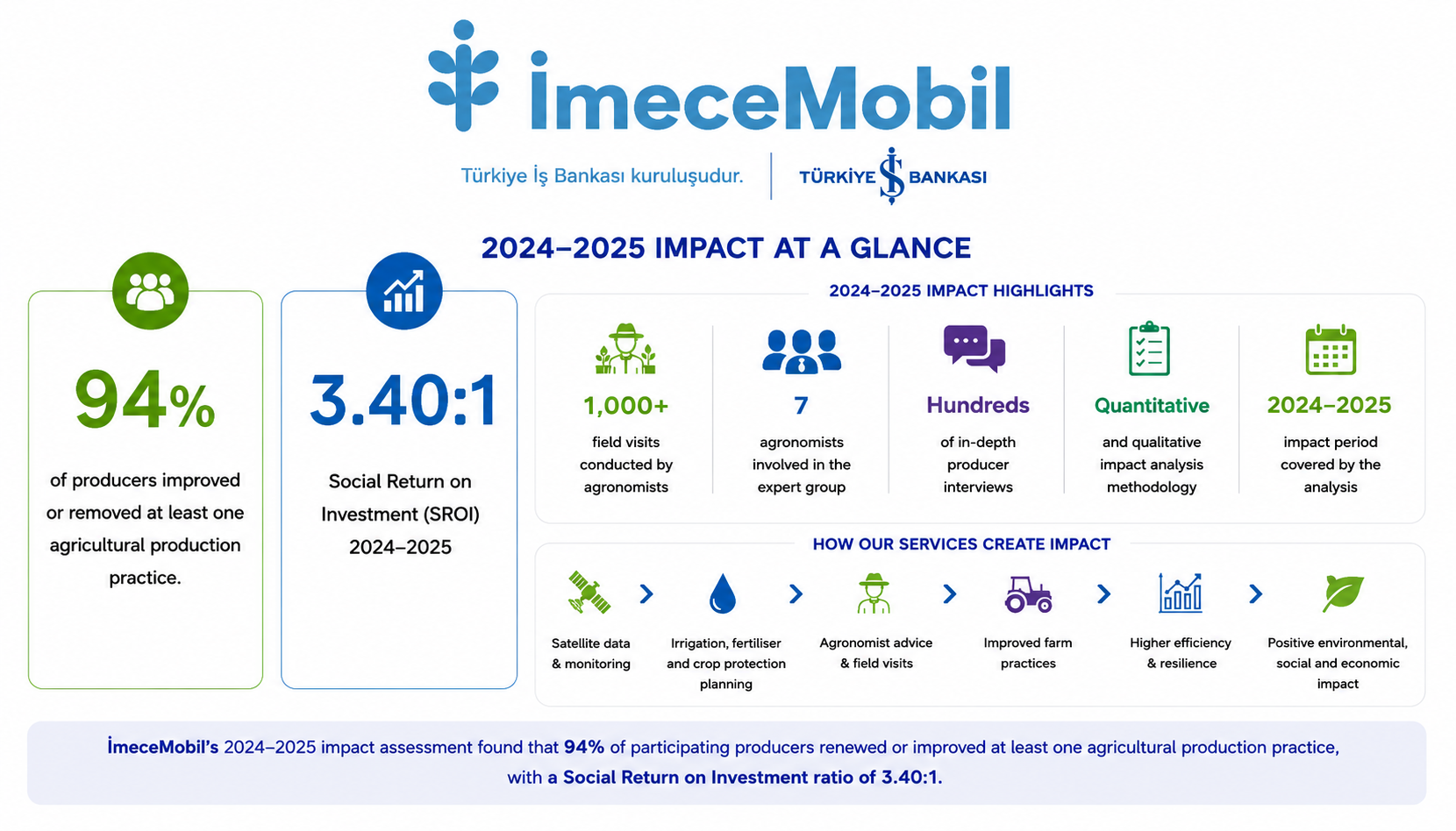
Figure 2: 2024-2025 Impact at a Glance
Impact
Sustainability Impact
Climate
This initiative is an enabler with indirect impact. The issuance of advice does not change the company's own Scope 1 or Scope 2 emissions, and no quantified greenhouse gas (GHG) figure is reported. The emissions it acts on are those of agricultural production in the producers' own fields, which fall under Scope 3: for the platform they arise through the use of the services provided, and for the parent bank they fall under Scope 3, Category 15: Investments, through its agricultural lending portfolio.
The enabling effect runs through the field decisions the service changes: producers who plan irrigation, fertiliser and crop protection on the basis of satellite data, soil analysis and agronomist advice apply inputs more precisely and build resilience against climate variability.
Over the 2024–2025 period covered by the impact analysis, producers confirmed that the satellite, irrigation calendar and fertiliser planning services, combined with soil analysis, contributed to resource savings and to more climate-resilient production, and 94% stated that they had renewed or improved at least one agricultural production practice. The European Green Deal process and the growing need for carbon measurement are expected to increase demand for field-level data of this kind.
Nature
Resource optimisation is the main nature-related effect. Water, fertiliser and crop protection use is planned against measured field conditions rather than by habit, and producers in the 2024–2025 analysis reported savings in these resources. The company reports the effect qualitatively and does not quantify the volumes saved.
Social
The social impact of the 2024–2025 period was assessed using the Social Return on Investment (SROI) methodology, comparing producer behaviour in the period of conventional production with the period in which the digital services were used. Based on the company's analysis, the SROI ratio was 3.40:1.
Of the producers analysed, 94% stated that they had renewed or improved at least one agricultural production practice. Seven agronomists in the expert group carried out more than 1,000 field visits, and hundreds of in-depth interviews were conducted.
The measured outcomes for producers cluster around resource saving, technical support and field interaction, data-based agricultural practice and monitoring, production efficiency and financial sustainability. Producers reported stronger agronomic knowledge and greater capacity to take production decisions from data rather than from experience alone.
Business Impact
Benefits
The model connects the company's technology with the parent bank's agricultural customer base, giving both a reason to invest in the same producers. Average monthly active users exceeded 200,000 in 2026 and purchases through the marketplace approached TRY 900 million over 2025–2026.
Data-based decisions can reduce unit input costs for producers, and the resulting field data can make agricultural credit scoring more transparent, which is a direct benefit for a lender with an agricultural portfolio.
Field visits, interviews and producer requests also operate as a continuous source of product intelligence: one request led to software that delivers accredited laboratory soil analysis results to the producer through the application, shortening the time between sampling and a fertiliser decision.
Costs
The company does not disclose investment figures. The main cost drivers are the technology infrastructure behind the platform and the budget allocated to specialist human resources, both of which the company treats as the basis for the initiative's medium and long-term continuity.
The field operation is the second cost driver. Agronomist time, farm visits and field training carry a cost per producer that does not fall as quickly as the cost of digital delivery. Because the core services are free of charge, the model depends on value-added services and marketplace activity to carry those costs. Rural digital literacy levels and technology infrastructure are the main risks to delivery, and are the reason the model retains a face-to-face component rather than operating on a purely digital basis.
Impact Beyond Sustainability And Business
Co-benefits
The service moves the agricultural value chain from an experience-based approach towards a data-based one, which the company treats as the start of a structural rural transformation. Producers gain agronomic knowledge and decision-making capacity that remains with them, and more transparent field data can improve their access to agricultural credit.
Potential side-effects
Digital literacy in rural areas and the state of technology infrastructure are the principal constraints on the model. They are managed by retaining agronomists in the delivery model, so that producers who cannot yet use the digital tools unaided still receive the advice, and by treating producers as decision-makers who shape the service rather than as recipients of it.
Implementation
Typical Business Profile
The model is most relevant to banks and financial groups with agricultural lending portfolios, and to agri-food companies working with contracted production. It suits geographies with fragmented smallholder farming, where producers are numerous, dispersed and not yet digitally equipped, and the service model is configured for holdings of any scale, from small family farms to large industrial holdings. The functions involved are agricultural banking, product and technology teams and field agronomy. The approach is transferable to food supply chains and sustainable finance, where technology-based traceability is required.
Approach
-
Start inside the parent organisation: Establish the venture under a corporate entrepreneurship model and incorporate it as a separate company once the service model is proven.
-
Provide a free core layer: Offer weather forecasts, agricultural alerts, season tracking, single-parcel satellite imagery and agronomist consultation without charge, so that producers can adopt the service before paying for anything.
-
Add value-added services: Price satellite plant health monitoring, irrigation management and fertiliser planning at accessible levels, and give large-scale and contracted production a dedicated web platform.
-
Combine digital and field delivery: Pair the digital services with face-to-face agronomist field visits through the parent bank's agricultural specialist branches, so that producers are guided in interpreting the data.
-
Form an expert group: Bring together the bank's agricultural banking marketing staff, the platform team and agronomists, and make the group responsible for technical accuracy, soil analysis interpretation and producer training.
-
Run two-way feedback: Convert producer requests from the field into product development, as when soil analysis results from an accredited laboratory were made available inside the application.
-
Measure social impact: Apply the SROI methodology, comparing producer behaviour before and after use of the services through in-depth interviews and field records.
-
Scale against annual targets: Set explicit annual producer coverage targets, review reach against them at the end of each season, and size agronomist capacity and field visit schedules to match the target for the following year.
Stakeholders Involved
-
Project leads: Senior management of the parent bank and of the company positioned digitalisation as a strategic priority and owned the initiative jointly, agreeing the annual producer targets and reviewing progress against them. A 13-person expert group runs field execution and control, reporting results back into that review.
-
Company functions: The bank's agricultural banking marketing department works alongside the platform team and the company's agronomists. Between them they are responsible for the technical accuracy of the digital services, the interpretation of soil analysis results, the transfer of agronomic knowledge to producers and the organisation of training.
-
Main providers: Soil analyses are carried out by an accredited laboratory, with the results delivered to producers through the application.
-
Other: Producers act as decision-makers rather than recipients: their needs, alongside the technical expertise of the expert group, determine what is built and how the service operates in the field.
Key Parameters To Consider
The underlying technologies, comprising satellite imagery, mobile applications and irrigation and fertiliser planning tools, are mature; the demanding element is field delivery. The initiative started in 2019, was incorporated in January 2023, and the ambassadorship service has run since 2024 on an annual cycle of producer targets and impact measurement.
Key prerequisites include:
-
agronomist capacity for field visits;
-
access to satellite imagery;
-
accredited soil analysis; and
-
a producer base reachable through banking channels.
Delivery depends on rural digital literacy and technology infrastructure. The service is configured for different microclimates and crop patterns and for holdings of any size.
Implementation And Operations Tips
The main obstacles are digital literacy and technology infrastructure in rural areas. The hybrid model addresses both: agronomists visiting fields make the digital services usable for producers who would not adopt them unaided, and their visits generate the data that improves the services. Keeping the core services free of charge lowers the barrier to first use.
Treating producers as decision-makers rather than as users, and converting their requests into product changes, is what sustains adoption. Wider replication is expected to combine a technology service with financing through multi-stakeholder partnerships.