
Context
Submitted through the COP31 Sustainable Transformation Awards · SKD Türkiye (WBCSD Global Network Partner)
Kredi Kayıt Bürosu (KKB) is a credit bureau and financial data infrastructure company in the information technology sector, with between 251 and 1,000 employees, providing shared data services to banks, financial institutions and the real sector.
Small and medium-sized businesses are increasingly asked for sustainability information by their banks, by the main contractors they supply and by regulators, but few of them hold the internal capability to answer. They have no standard question set to work to, no way of calculating a carbon footprint, and no comparable output that a third party would accept.
On the other side of the same gap, banks and public institutions assessing those businesses receive information in inconsistent formats that cannot be compared across a portfolio or a supply chain.
Recognising the need for a common, reliable and comparable sustainability data infrastructure, the company brought its expertise in data and technology into the sustainability field and launched Greendeks in September 2024. Built to close this gap from the infrastructure side rather than from either end of it, Greendeks is a digital sustainability assessment platform that evaluates the environmental, social and governance (ESG) performance of a business through question sets specific to its sector, reports the result, and identifies where the business needs to improve.
Governance sits with a Sustainability Committee operating under the Board of Directors, with product development, data management, technology, business development and sustainability functions represented, and the platform is developed as part of the company's own digital transformation and sustainability objectives rather than as a standalone product launch.
Location of the initiative: Türkiye, nationwide digital platform covering 36 sectors
Solution
The platform turns a sustainability assessment into a structured digital process. A business completes a sector-specific question set, enters required data, uploads supporting documentation and uses the calculation tools built into the platform. The assessment is then carried out based on the information entered by the business, together with supporting data and documentation provided through the platform.
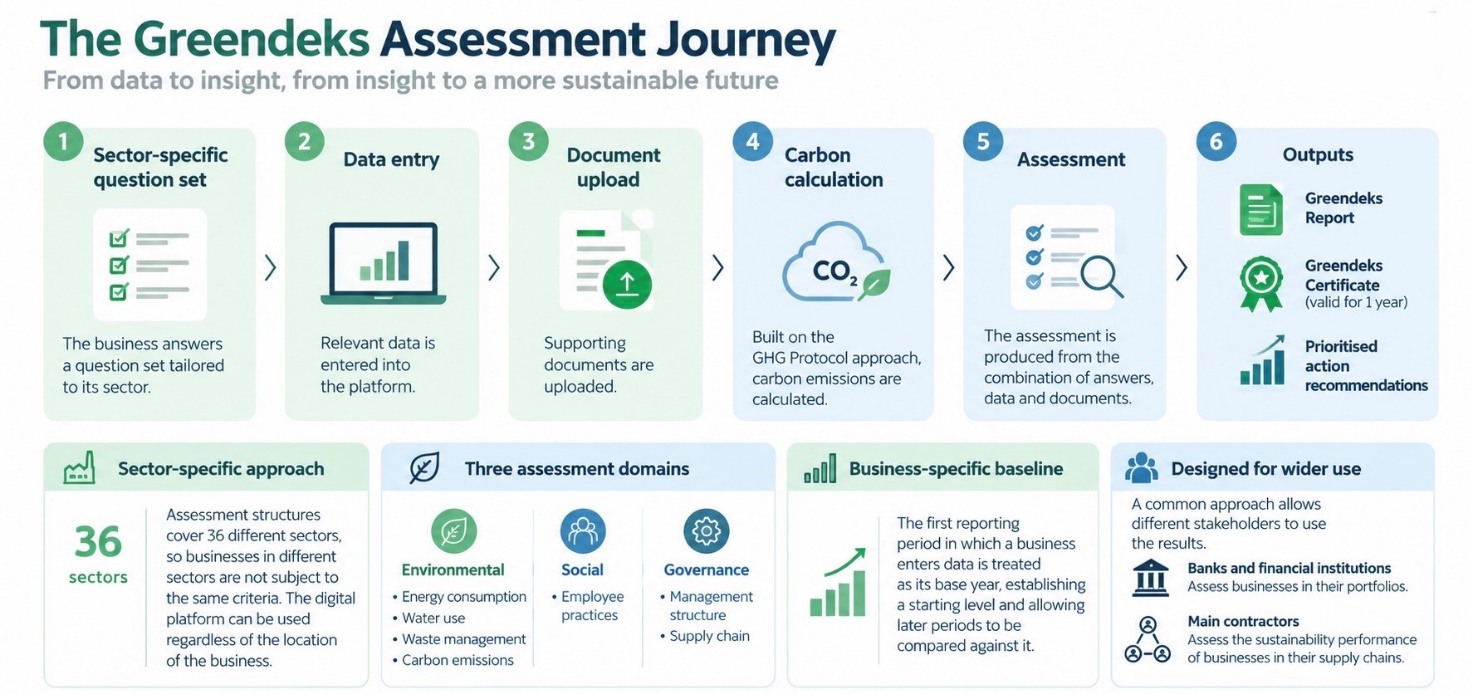
Assessment covers three domains. The environmental domain includes topics such as energy consumption, water use, waste management and carbon emissions. The social domain covers employee practices. The governance domain covers the management structure and the supply chain. A carbon footprint calculation tool supports the environmental domain, built on the GHG Protocol approach.
Sector specificity is what makes the result usable. The platform includes assessment structures for 36 different sectors, meaning that businesses operating in different sectors are not assessed against the same criteria. Each business is evaluated based on the requirements relevant to its own sector. As a fully digital platform, Greendeks can also be accessed and used by businesses regardless of their location.
Three outputs are generated. The Greendeks Report sets out environmental, social and governance performance, the index result, the carbon footprint outputs and the development areas in quantitative terms. The Greendeks Certificate, valid for one year, carries the business title, sector of activity, assessment date, validity period and index result. Prioritised action recommendations form an action plan of the improvements the business should make and the sustainability practices it can apply.
The baseline is set per business rather than centrally: the first reporting period in which a business enters data is treated as its base year, which establishes a starting level and allows later periods to be compared against it.
The result is designed to be used by others as well as by the business itself. Banks and financial institutions can assess the businesses in their portfolios, and main contractors can assess the sustainability performance of the businesses in their supply chains, using a common approach instead of bespoke questionnaires.
Figure 1: The Greendeks assessment journey from the business's side: from logging in and completing the sector-specific assessment to receiving the index result, report, certificate and prioritised action plan
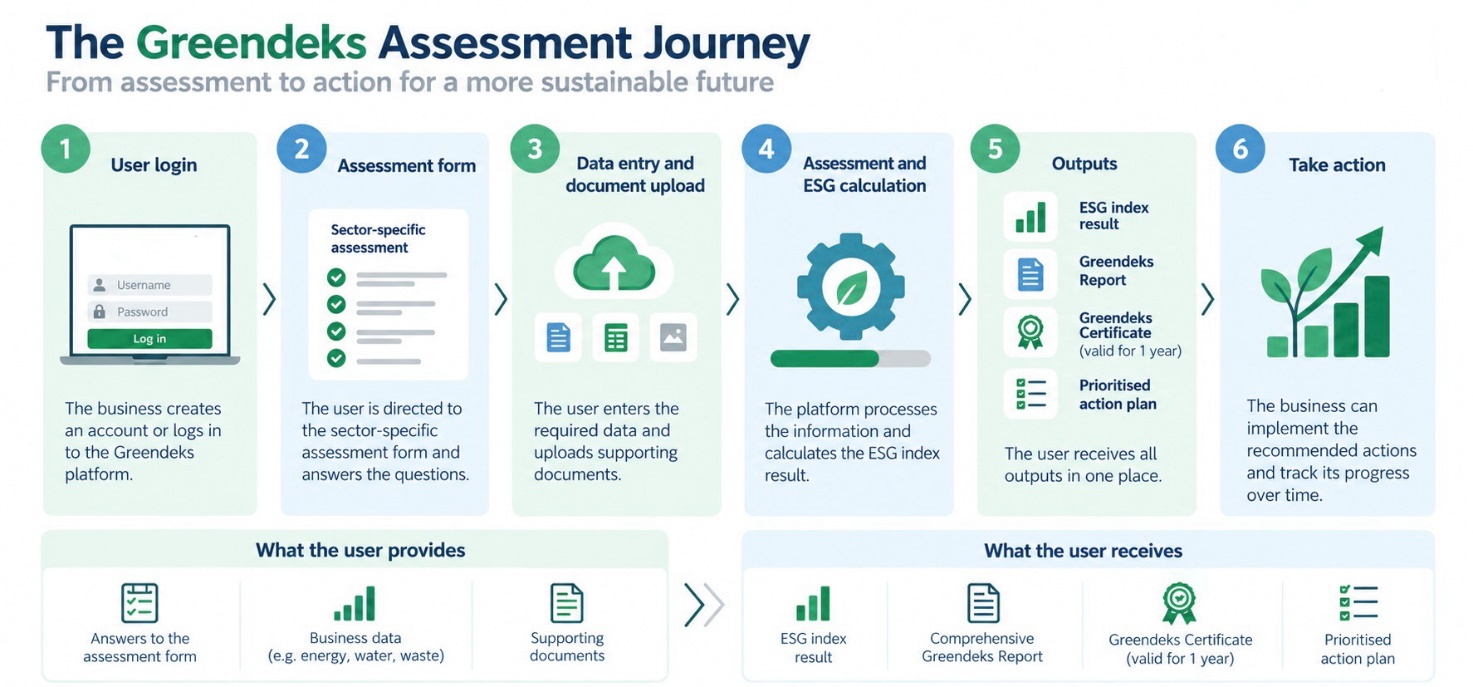
Figure 2: How the assessment is built: sector-specific question sets, data entry, document upload and a GHG Protocol-based carbon calculation, across 36 sectors and three assessment domains
Impact
Sustainability Impact
Climate
The platform is an enabler: the emissions it addresses belong to the businesses assessed, not to the operator of the platform, whose own operational footprint is managed separately.
The carbon footprint calculation tool follows the GHG Protocol approach and supports the calculation of Scope 1, Scope 2 and relevant Scope 3 emissions, which for most small and medium-sized users is the first structured emissions calculation they have carried out.
Because the base year is set as the first reporting period in which a business enters data, each user gains a reference point against which later periods can be measured, so the platform produces the measurement infrastructure for reduction rather than the reduction itself.
By turning climate-related data into measurable and comparable insights, the platform helps businesses identify improvement areas, track their environmental performance over time and support their transition towards lower-carbon operations.
Nature
The environmental module assesses resource use directly, covering energy consumption, water use and waste management alongside carbon emissions, and the prioritised action recommendations returned to each business identify where those areas need improvement.
Because the assessment is repeated in later reporting periods, a business can track progress in resource use rather than only in emissions.
Social
The user base is weighted towards small and medium-sized enterprises, the segment least likely to have internal sustainability capability, and the heaviest participation has come from the wholesale trade sector.
The most frequently observed index result is C+, which places the typical user in the middle of the scale and identifies a large population of businesses with defined development areas rather than a small group of advanced performers.
Access to finance is the clearest social outcome. Through a collaboration with a state-owned bank, green export credit and green investment credit packages backed by the national credit guarantee scheme have provided over TRY 4 billion in financing to more than 300 businesses.
Training and awareness activity with representatives of different sectors extends the platform's effect beyond its users, and a protocol signed with the Ministry of Environment, Urbanisation and Climate Change provides a basis for using public data in sustainability assessment and for work on green transformation in industry.
Business Impact
Benefits
The platform extends an existing role in shared financial data infrastructure into sustainability data, using the same position of trust between banks, public institutions and the real sector.
Adoption is measurable: over 500 businesses have completed a Greendeks assessment and received their certificate since September 2024, and the number of certified businesses is tracked and reported alongside the number of businesses supported through green financing and the financing amount.
Integration into the financial system is the strongest commercial signal. Index results are used as one of the assessment criteria in green financing and guarantee support mechanisms, and over TRY 4 billion in financing has reached more than 300 businesses through the green export and green investment credit packages delivered with a state-owned bank.
Use cases have widened beyond banking. Value chain assessments have been carried out in the real estate sector, and the protocol with the Ministry of Environment, Urbanisation and Climate Change opens a route into public sector work on green transformation in industry.
For the businesses assessed, the benefits are a report, an annually valid certificate and a prioritised action list.
Costs
The platform was built and is maintained by the operator. The company's technical and operational capability was combined with expert consultancy support, and the human resources and corporate resources required for development and continuous improvement were provided internally rather than through a partnership vehicle.
The recurring cost is content maintenance. Assessment structures for 36 sectors have to be kept current as regulation, reporting expectations and sector practice change.
Certificate validity of one year builds a re-assessment cycle into the model, which is a benefit for data currency but a repeated effort for the user.
The varying levels of data maturity and sustainability awareness among businesses represent an important area for development. The platform supports businesses in building a more structured approach to sustainability data, helping them better understand their current performance and identify areas for improvement.
The broader adoption of the platform can be further strengthened through engagement across the financial and business ecosystem. Collaboration with banks, guarantee institutions and other relevant stakeholders can support the wider use of sustainability data and assessment outputs across different processes.
Impact Beyond Sustainability And Business
Co-benefits
A common assessment language reduces duplicated effort across the market. A business that would otherwise answer a different sustainability questionnaire for every bank and every main contractor completes one structured assessment whose output several parties accept.
Prioritised action recommendations help businesses identify their sustainability-related development needs and support them in developing their transformation roadmaps.
Because the platform is digital, it reaches businesses regardless of geography, so firms outside the main industrial centres are assessed on the same basis as those inside them.
Potential side-effects
A single index result can be read as an indicator of a business's sustainability performance rather than a definitive assessment. With C+ the most frequent result, the score is best used to identify areas for improvement and provide a structured view of sustainability performance, rather than being considered on its own in financing-related assessments.
Assessment rests on data and documents supplied by the business, so output quality depends on input quality, and the platform measures the sustainability performance that can be assessed based on the information and supporting evidence provided.
Linking the score to credit creates an incentive to score well as well as an incentive to improve, which makes the reliability and consistency of supporting data and documentation an important part of the assessment process.
Annual certificate validity keeps data current but also provides businesses with an opportunity to periodically reassess their sustainability performance and track their progress over time.
Implementation
Typical Business Profile
The model suits organisations that already sit between many counterparties as shared infrastructure, credit bureaus, financial data providers, sector associations or exchanges, because the value of a common sustainability index depends on several institutions using or recognising the same structured output.
It is most applicable in markets with a large population of small and medium-sized businesses facing sustainability information requests from banks, supply chain customers and regulators, but without the internal capability to answer them.
Delivery requires product development, data management, technology, business development and sustainability functions working together, a sustainability governance structure with board-level oversight, and institutional relationships with banks, guarantee mechanisms and public bodies that will use the output.
Approach
-
Build the question sets by sector rather than by generic template: Develop assessment structures for each sector in scope so that the questions match the material issues of the business being assessed, which is what makes the resulting score comparable within a sector rather than merely consistent across all of them.
-
Digitise the whole assessment path: Combine question sets, data entry, document upload and calculation tools in one platform so that evidence is captured with the answer, rather than collecting responses and requesting supporting documents afterwards.
-
Embed a carbon calculation tool built on a recognised standard: Base the footprint calculation on the GHG Protocol approach covering Scope 1, Scope 2 and the relevant Scope 3 emissions, so that the output is credible to the banks and customers who will read it.
-
Set the base year per business, not centrally: Treat the first reporting period in which a business enters data as its base year, which lets firms at very different starting points join the same system and still measure their own progress.
-
Return three outputs, not one score: Issue a report quantifying performance and development areas, a certificate valid for one year that carries the business title, sector, assessment date, validity period and index result, and a prioritised set of action recommendations that provides practical guidance on the improvements the business can consider next.
-
Make the result usable by third parties: Design the output so that banks can assess the businesses in their portfolios and main contractors can assess their supply chains through a common approach, which is what turns an assessment into market infrastructure.
-
Sign institutional agreements that give the score consequence: Establish protocols with public authorities for the use of public data and integrate the index result into green financing and guarantee support mechanisms, so that improving the score has a financial return for the business.
-
Track adoption and progress over time: Monitor the number of businesses completing the assessment and track changes in their sustainability performance over successive assessment periods, providing a clearer view of both platform adoption and businesses' progress over time.
Stakeholders Involved
-
Project leads: The platform is developed with senior management support as one of the applications of the company's sustainability strategy and is managed as part of the corporate structure rather than as a project. Governance is supported by a Sustainability Committee operating under the Board of Directors, in which different departments are represented, so that product development, data management, technology, business development and sustainability work are coordinated rather than sequenced. This governance model is what has kept the platform in continuous development rather than allowing it to become a single delivery.
-
Company functions: Product development, data management, technology, business development and sustainability functions work together on the platform. The company's technical and operational competencies were brought together with expert consultancy support during development, and the human and corporate resources required for building and continuously improving the platform were provided internally.
-
Main providers: External expert consultancy supported the design of the assessment methodology and the sector question sets, working alongside the internal technical teams. Financial institutions integrate the platform into their own processes, which makes them delivery partners rather than only customers, and a state-owned bank delivers the green export and green investment credit packages in which the index result is used as an assessment criterion, backed by the national credit guarantee scheme.
-
Other: The Ministry of Environment, Urbanisation and Climate Change is a decisive external stakeholder: a signed protocol created the basis for public data to be used in sustainability assessment processes and for joint work on green transformation in industry. Banks integrated into the platform assess the sustainability performance of the firms in their portfolios and provide feedback on the process. Real sector firms use the platform both for their own performance and, where needed, to bring the stakeholders in their value chains into assessment. The structure formed between public institutions, the financial sector, the real sector and the operator supports project design, the development of use cases, feedback collection and platform improvement, and training and awareness work with representatives of different sectors extends the model beyond its direct users.
Key Parameters To Consider
The platform has been live since September 2024, so the results reported here cover its first period of operation rather than a mature installed base.
Certificates are valid for one year, which sets the natural re-assessment cycle and means the number of certified businesses reflects an active population rather than a cumulative count of first-time users.
Coverage is defined by the 36 sector question sets: a business in a sector without a question set cannot be assessed, so extending sector coverage is the main lever for widening the addressable base.
The platform's continued development depends on keeping its assessment framework aligned with evolving sustainability requirements and sector-specific needs. Regular review of question sets and assessment criteria helps maintain the relevance and consistency of the model over time.
Implementation And Operations Tips
Attach a consequence to the score as early as possible. Adoption moved when index results became one of the assessment criteria in green credit and guarantee mechanisms, because that gave businesses a reason to complete an assessment they had no regulatory obligation to complete.
Per-business base years remove the barrier to entry. Requiring a common baseline year would exclude firms that have never measured anything, which is most of the target population.
Returning actions, not just a grade, is what makes the platform useful to a small business. A score identifies a problem; a prioritised action plan is what a firm without a sustainability team can actually act on.
Sector-specific question sets cost more to build and maintain than a single generic set, but a generic assessment produces results that neither the business nor its bank trusts.
Public sector data agreements are worth pursuing early, because they reduce the data entry burden on the user and raise the credibility of the output at the same time.